
Understanding Headache Locations and Meanings
Headaches can vary widely in their location, but what does headache location mean? The specific area where pain is concentrated can provide insights into the type of headache you may be experiencing.
However, what most people do not know is that providing a headache diagnosis or cause is impossible based on headache location alone without any details of pain attack duration, frequency, description, pattern, medical history, or associated features occurring with the headache such as nausea, sensitivity to light and sound, a red or tearing eye on one side, a runny nose or stuffy nose on the side of pain, droopiness of an eyelid, puffiness around the eye, hearing disturbances, and neurological symptoms such as vision disturbances, numbness and tingling, weakness, or speech disturbances, among other symptoms. A neurological examination is also necessary to help confirm the possibilities.
In other words, headaches are not diagnosed only by their location, but more importantly by the “company they keep”. The associated symptoms occurring with the headache are even more important than headache location alone.
So when a patient comes into my office, points to where their headache pain is, and asks me what kind of headache it is, it’s impossible to give them a diagnosis based purely on location, without diving deeper into more specific details. So I say, “we’ll come back to that, but first I want to hear more about the headache.” Ultimately, a skilled headache history discussion is mandatory for an accurate diagnosis.
Headache location is certainly helpful when trying to distinguish between different headache types which occur in the same location. For example, there are many different types of headaches that cause pain around one eye or one side of the head pain such as migraine, cluster headache, hemicrania continua, paroxysmal hemicrania, and many others. They all have much different treatments though, so narrowing down the most likely is key. However, these possibilities cannot be differentiated from one another to formulate the best treatment plan without additional details.
For example, severe, piercing pain attacks around one eye only lasting 15 minutes up to 3 hours max, with a tearing and red eye and nasal congestion on one side only, which come in attack cycles lasting weeks to months would suggest cluster headache. Another person with throbbing pain in the same area, along with similar sinus congestion, nausea, and sensitivity to light and sound, lasting more than 4 hours would be more consistent with migraine and would be treated differently. These are just 2 of hundreds of similar examples of why headache location alone really tells you nothing.
This FREE headache and facial pain symptom checker tool incorporates not only location of headache, but also all of these important characteristics and associated symptoms into an algorithm. Think of these questions like a simulated office visit with a headache specialist. This information will give you a more accurate personalized list of possible headache or facial pain disorders to discuss with your doctor. From that list, you can click on each one to learn the most common treatment plans for that specific headache type. I created this tool purely for educational purposes, it does not provide a definitive diagnosis. However, it will be a good starting point on your journey to figuring out your headache type and how to treat it with your doctor.
Types of Headaches Based on Location; Using a Headache Chart
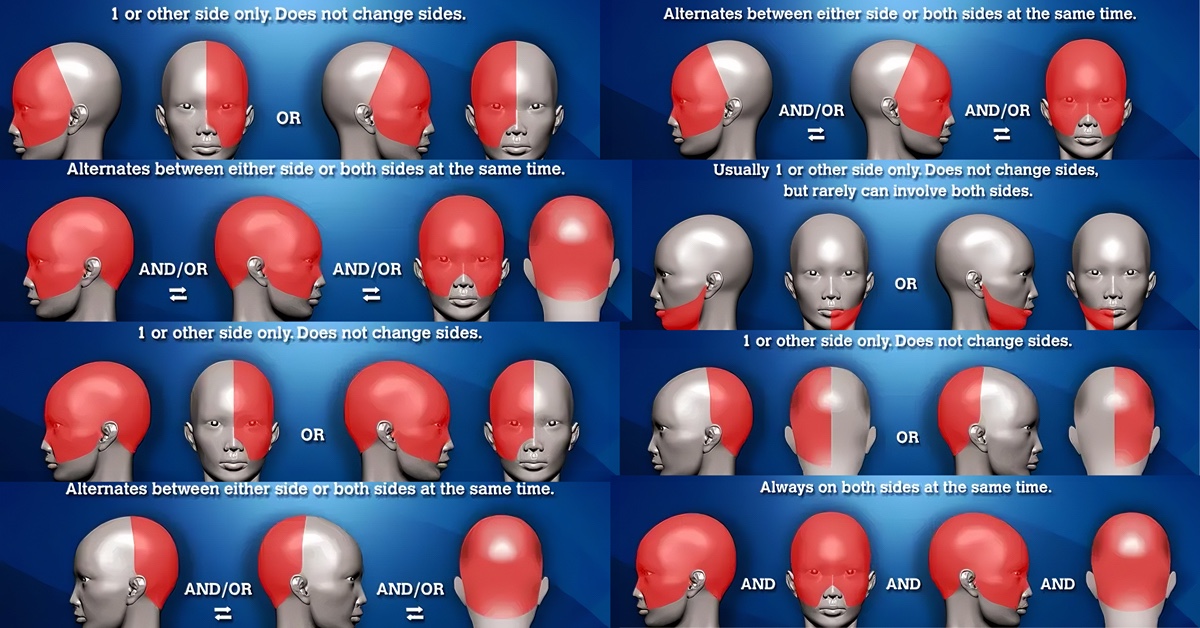
A headache chart can be a practical resource for understanding the connection between the location of your headache and its potential causes. I’ve noticed that there are many “headache charts”, “location of headache meaning”, “complete headache charts”, etc. floating around on the internet. As a headache specialist, I can tell you that they are pretty much all nonspecific, generic, and generally useless. So I felt like I needed to step in and provide better direction and information.
Location of your headache is an important piece of information, and a headache chart is like a map in giving direction to headache types based pain location. However, it doesn’t tell the whole story, nor can it give an accurate diagnosis without knowing all of the associated symptoms and features. Therefore, this will be the most useful and the only headache chart you’ll ever need…
Think about everything that happens during your usual headache attack; the location, does it stay on one side or switch sides, where in the head is the pain, what’s the character of the pain, is there nausea, is there sensitivity to light and/or sensitivity to sound, is there eye redness, tearing, or nasal congestion on the affected side, and then run all those features through this FREE headache and facial pain symptom checker tool. Below are some of the most common types of headaches and facial pains according to the headache or facial pain location, based on International Headache Society criteria.
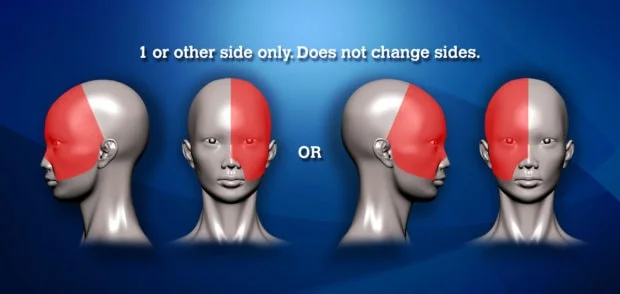
Side-Locked One-Sided Headache Always on the Same Side: Forehead, Temple, or Cheek Pain (Strictly Unilateral Headache)
If you have a headache that is 100% always on one side of your head only — specifically in the forehead, cheek, or temporal (temple) area — and it never alternates sides nor affects both sides at the same time, this is a classic side-locked or strictly unilateral headache.
Key Characteristics:
- The headache is 100% fixed to one side only
- It never switches between the left and right side
- It never becomes bilateral (both sides involved)
One-Sided Headache Types to Discuss with Your Doctor or Headache Specialist:
–Migraine (classic one-sided attacks, but can present as bilateral whole-head pain too)
–Cluster Headache (severe unilateral pain)
–Hemicrania Continua (continuous one-sided headache)
–Trigeminal Neuralgia (sharp facial pain in forehead, cheek, or temple)
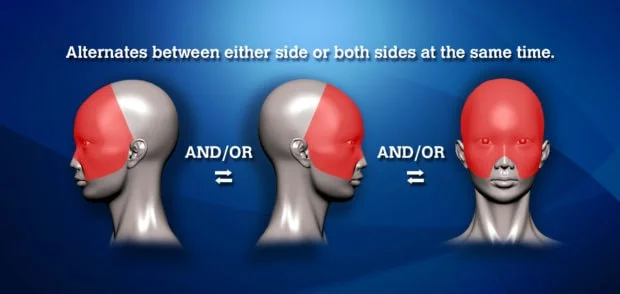
Variable One-Sided Headache That Switches Sides or Becomes Bilateral: Forehead, Temple, or Cheek Pain
Your headache varies in location within the forehead, cheek, or temporal area. It may alternate between sides, occur more often on one side (but not always), or sometimes involve both sides of the head at the same time.
Key Characteristics:
- Variable headache location that can switch sides
- May favor one side but is not 100% fixed
- Can be unilateral or bilateral at different times
Headache Types to Discuss with Your Doctor or Headache Specialist:
–Migraine (classic one-sided attacks, but can present as bilateral whole-head pain too)
–Tension-Type Headache (classic bilateral tight band-like pain, most common type of headache)
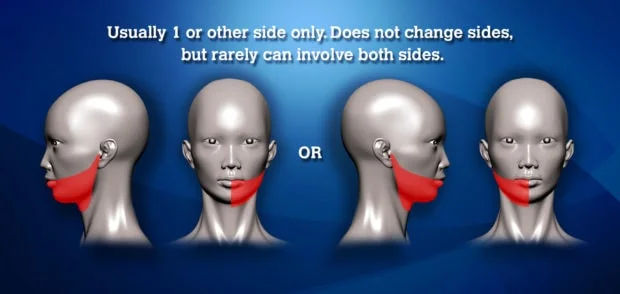
Facial Pain in Chin, Jaw, Throat, Ear, or Tongue Area (One-Sided Facial Neuralgias)
Pain located beneath the angle of the lower jaw, back of the throat or tonsils, base/back of the tongue, inside the ear, or deep in the ear is typically facial pain rather than a standard headache.
Facial Pain and Neuralgia Types to Discuss with Your Doctor or Headache Specialist:
–Trigeminal Neuralgia (most common cause of one-sided facial pain in cheek/jaw)
–Glossopharyngeal Neuralgia (throat, tonsil, and deep ear pain)
–Geniculate Neuralgia (Nervus Intermedius Neuralgia) (deep ear severe pain)
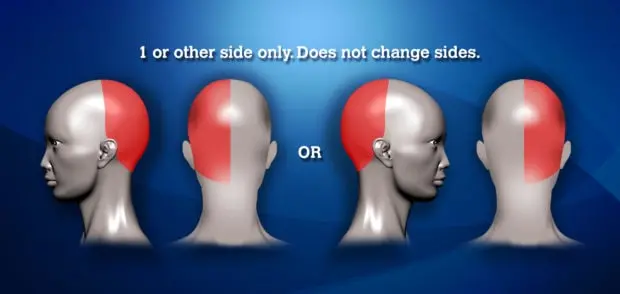
Side-Locked Occipital Headache Always on One Side Only: Back of Head Pain (Strictly Unilateral)
If your headache is 100% always on one side only in the parietal-occipital area (focused in the back half of your head) and it never alternates sides or affects both sides at the same time, this is a side-locked unilateral occipital headache. Many times there is associated neck pain, and this can also suggest cervicogenic headaches.
Key Characteristics:
- Strictly one-sided back-of-head pain
- Never switches sides
- Never bilateral
Headache Types to Discuss with Your Doctor or Headache Specialist:
–Migraine (classic one-sided attacks, but can present as bilateral whole-head pain too)
–Occipital Neuralgia (shooting or electric pain in back of head and neck)
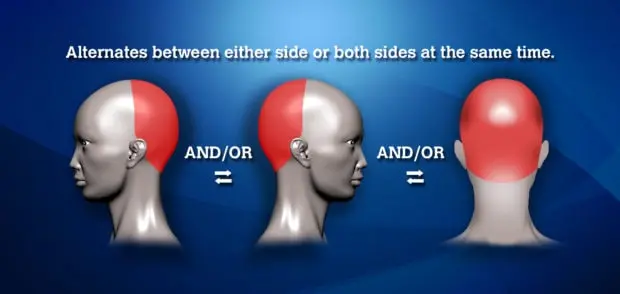
Variable Occipital Headache That Switches Sides or Becomes Bilateral: Back of Head Pain
Your headache in the parietal-occipital area (back half of the head) varies in location. It may alternate between sides in the back of the head, occur more often on one side (but not always), or sometimes involve both sides of the head at the same time. Many times there is associated neck pain, and this can also suggest cervicogenic headaches.
Key Characteristics:
- Variable back-of-head headache location
- Can switch sides or be bilateral
Headache Types to Discuss with Your Doctor or Headache Specialist:
–Migraine (classic one-sided attacks, but can present as bilateral whole-head pain too)
–Tension-Type Headache (classic bilateral band-like pain, most common type of headache)
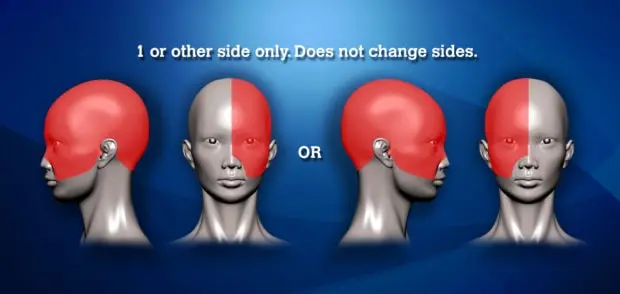
Strictly Unilateral Whole-Side Headache Always on the Same Side: Entire Side of Head Pain (Forehead to Occipital Area)
The headache affects the whole side of your head (forehead, cheek, temple, parietal, and occipital areas) and is 100% always on one side only. It never alternates and never involves both sides at the same time.
Key Characteristics:
- Side-locked pain across the entire side of the head
- Never switches sides
- Never bilateral
One-Sided Headache Types to Discuss with Your Doctor or Headache Specialist:
–Migraine (classic one-sided attacks, but can present as bilateral whole-head pain too)
–Hemicrania Continua (continuous whole-side headache)
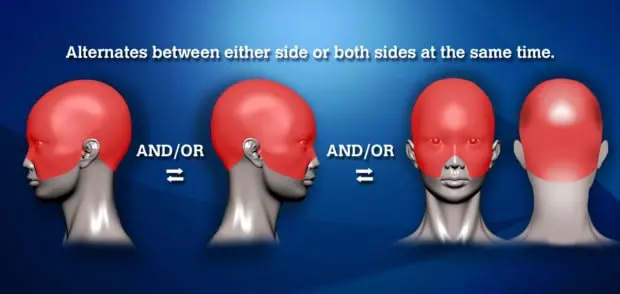
Variable Whole-Side Headache That Switches Sides or Becomes Bilateral: Entire Side of Head Pain
Your headache location varies across the whole side of the head (forehead, cheek, temple, parietal, and occipital areas). It may alternate between sides, favor one side more often (but not always), or sometimes involve both sides of your head at the same time.
Key Characteristics:
- Variable pain across the entire side of head
- Can switch sides or become bilateral
Headache Types to Discuss with Your Doctor or Headache Specialist:
–Migraine (classic one-sided attacks, but can present as bilateral whole-head pain too)
–Tension-Type Headache (classic bilateral band-like pain, most common type of headache)
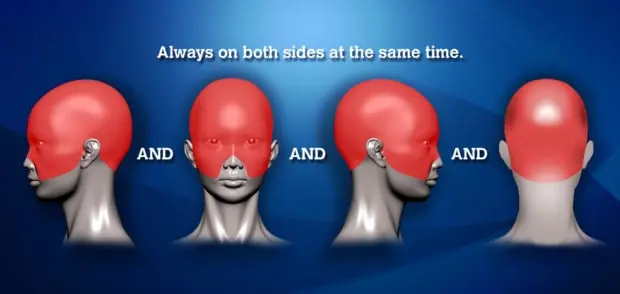
Bilateral Whole-Head Headache Always on Both Sides: Entire Head Pain Affecting Both Sides Simultaneously
Your headache is never on one side only. It always involves the whole head on both sides at the same time (forehead, cheek, temple, parietal, and occipital areas bilaterally).
Key Characteristics:
- Always bilateral whole-head pain
- Never strictly unilateral
Headache Types to Discuss with Your Doctor or Headache Specialist:
–Tension-Type Headache (classic bilateral band-like pain, most common type of headache)
–Migraine (can present as bilateral whole-head pain)
–Other chronic headache disorders
Headache Chart Limitations
The headache types listed above only include primary headaches (such as migraine, cluster headaches, tension headaches, etc.). Primary headache disorders are usually benign headaches in contrast to secondary headaches, which are caused by underlying medical conditions such as brain tumor, brain aneurysm or problem with the blood vessels, infection, trauma, etc.
Here are a few additional primary headache disorders listed below, as well as some secondary headache disorders, that could potentially manifest in any of these headache pain locations above as well:
–New Daily Persistent Headache (NDPH)
–Medication Overuse Headache (Rebound Headache)
–Primary Headache Associated with Sexual Activity
Secondary headaches require medical attention and sometimes emergent medical care (such as headache with a stiff neck with fever and confusion, thunderclap severe immediate onset headache, “worst headache of your life”, or severe headache during sexual intercourse as a few of many examples). These headache maps are not meant to identify any type of secondary headache or facial pain disorders, only primary headache disorders.
A secondary headache caused by an underlying cause triggering the pain can also look like any primary headache disorder (such as sinus infection causing sinus headaches). Thus, any type of headache ALWAYS requires an office visit with your doctor to fully discuss symptoms, do a neurological and medical exam, and order appropriate diagnostic tests such as brain scans, lumbar puncture, blood work, or other testing, depending on the headache story. Your doctor will be able to decide whether further testing is necessary based on all of this information obtained in an office visit.
Being aware of red flag symptoms is essential. Warning signs such as sudden, severe abrupt headache pain (thunderclap headache), confusion, difficulty speaking, vision loss, numbness, unsteadiness, balance problems, vertigo, or weakness in any part of the body may signal a medical emergency and require immediate attention.
Conclusions
Tension-type headaches followed by migraine headaches are the most common types of headaches. However, the bottom line is that headache type cannot be determined only by the location of your headache pain. Proper diagnosis requires a detailed history of all associated symptoms, pattern, and character of the pain along with medical history and examination. Therefore, every headache should be discussed and evaluated with your doctor for proper evaluation and choosing the right treatment options, including lifestyle changes, and prescription medications.
I hope this headache chart and headache and facial pain symptom checker tool help personalize your self-research, and help point you and your healthcare provider in the right direction! Ultimately, I hope that this information helps you get answers, a better quality of life, and less headache disruption of your function and life!
IF YOU HAVE HEADACHE, MIGRAINE, OR FACIAL PAIN AND ARE LOOKING FOR ANSWERS ON ANYTHING RELATED TO IT, A HEADACHE SPECIALIST IS HERE TO HELP, FOR FREE!
FIRST, LET’S DECIDE WHERE TO START:
IF YOU HAVE AN EXISTING HEADACHE, MIGRAINE, OR FACIAL PAIN DIAGNOSIS AND ARE LOOKING FOR THE LATEST INFORMATION, HOT TOPICS, AND TREATMENT TIPS, VISIT OUR FREE BLOG OF HOT TOPICS AND HEADACHE TIPS HERE. THIS IS WHERE I WRITE AND CONDENSE A BROAD VARIETY OF COMMON AND COMPLEX MIGRAINE AND HEADACHE RELATED TOPICS INTO THE IMPORTANT FACTS AND HIGHLIGHTS YOU NEED TO KNOW, ALONG WITH PROVIDING FIRST HAND CLINICAL EXPERIENCE FROM THE PERSPECTIVE OF A HEADACHE SPECIALIST.
IF YOU DON’T HAVE AN EXISTING HEADACHE, MIGRAINE, OR FACIAL PAIN DIAGNOSIS AND ARE LOOKING FOR POSSIBLE TYPES OF HEADACHES OR FACIAL PAINS BASED ON YOUR SYMPTOMS, USE THE FREE HEADACHE AND FACIAL PAIN SYMPTOM CHECKER TOOL DEVELOPED BY A HEADACHE SPECIALIST NEUROLOGIST HERE!
IF YOU HAVE AN EXISTING HEADACHE, MIGRAINE, OR FACIAL PAIN DIAGNOSIS AND ARE LOOKING FOR FURTHER EDUCATION AND SELF-RESEARCH ON YOUR DIAGNOSIS, VISIT OUR FREE EDUCATION CENTER HERE.